
Campus France Interview
Campus France Student Visa Interview Questions and Answers

The last blog we wrote dealt with questions asked in German student visa interviews and how you can deal with them. Of course, how can students going to France be left behind in this matter - so we had to make one for the student visa interviews conducted by Campus France as well! Again, interviews can be quite nerve-wracking, but they are far from insurmountable and after this blog, you’d know that’s indeed the case.
So if you’re gearing up to study in France and have an interview lined up after applying for a France student visa, this can push your anxieties away. Now, without further adieu, let’s tackle each question! We will offer up an explanation as to why they’re asking the question and how you can best approach it along with an example. Sounds good? Let’s dive in.
Campus France Interview at a Glance
| Feature | Details |
|---|---|
| Interview Duration | Usually 15 to 30 minutes |
| Interview Mode | In-person or online (depending on process) |
| Language | English or French, depending on the programme |
| Purpose | Verify your study plan, motivation, and academic profile |
| Difficulty | Moderate if well prepared |
What Is the Campus France Interview?
The Campus France interview is an important step for many Indian students applying to study in France. It is conducted by a Campus France advisor to understand your academic background, study plans, and reasons for choosing France as your study destination.
Unlike a France student visa interview, the Campus France interview focuses on your education and future goals rather than your visa eligibility. The interviewer wants to understand whether you have chosen the right course and university, and whether your study plans align with your career aspirations.
During the interview, you may be asked about your previous education, the programme you have selected, your knowledge of the university, your financial planning, and your plans after graduation. The discussion is usually conversational, so there is no need to memorise answers. Honest and well-prepared responses leave a better impression than scripted ones.
Understanding the purpose of the Campus France interview can help you prepare confidently and answer questions with clarity.
What Does the Interviewer Evaluate During the Campus France Interview?
The purpose of the Campus France interview is not to test your English or ask trick questions. Instead, the interviewer evaluates whether you have a genuine study plan and are well prepared for your education in France.
During the Interview, They Generally Assess:
- Your academic background and previous qualifications.
- Your reasons for choosing France, the university, and the course.
- Your understanding of the programme and future career goals.
- Your financial preparedness for studying and living in France.
- Your confidence, communication skills, and clarity of thought.
- Whether the information you provide matches your application documents.
The interviewer also looks for consistency. Your answers should align with your Statement of Purpose (SOP), academic records, and other supporting documents. If your study plans are realistic and your responses are genuine, you are more likely to have a successful Campus France interview.
France Student Visa Questions And Answers
Q1. What is your full name? / Introduce yourself.
Why: It’s basically an icebreaker question, a bit of small talk to get to know you while helping you acclimatise.
Solution: Confidence, confidence, confidence - approach with confidence, tell them your name, your academic background, and a bit about what you plan to do in the future. Do not babble though - keep it succinct.
Exhibit: “My name is [Your Name]. I have recently completed my Bachelor’s degree in [Your Field] from [Your University]. I am passionate about [Your Interest], and I am looking forward to pursuing my Master’s in [Your Course] in France.”
Q2. How many percentages did you secure in your Bachelor’s?
Why: To assess your academic performance and consistency in your studies.
Solution: Mention your percentage or grade point and highlight your strengths. If your grades are slightly lower, focus on your efforts to improve and your passion for the field.
Exhibit: “I secured [Your Percentage/Grade] in my Bachelor’s degree. My strong performance in subjects like [Key Subjects] reflects my dedication to this field.”
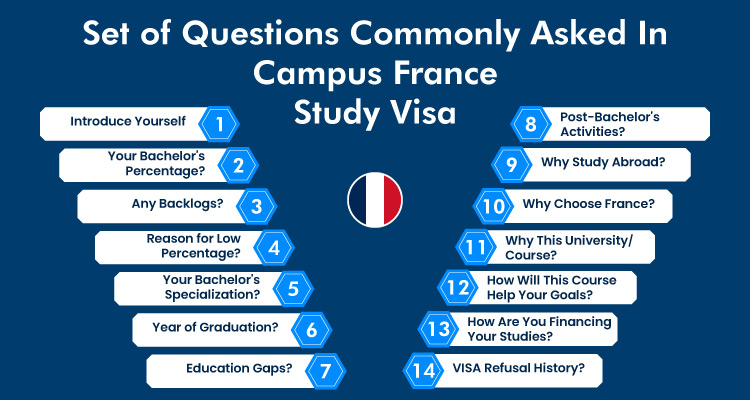
Q3. Do you have any backlogs? / What is the reason for getting backlogs?
Why: To evaluate your ability to manage academic challenges.
Solution: If you had backlogs, explain them honestly but ensure you emphasize how you overcame them and what you learned.
Exhibit: “I had [Number] backlogs due to [Reason, e.g., health issues]. However, I worked hard to clear them and achieved excellent results in subsequent semesters.”4. Why didn’t you choose to study this course in your home country?
Q4. Why is your percentage too low?
Why: To understand any gaps in your academic performance.
Solution: Acknowledge the issue, provide a genuine reason, and focus on how you’ve worked to improve.
Exhibit: “My percentage was slightly lower in my second year due to [Reason]. However, I focused on improving my performance and excelled in my final year.”
Q5. What was the specialization of your Bachelor’s?
Why: They are trying to understand your journey, like how it’s relevant to what you’d be pursuing in France.
Solution: Just share what you specialised in and explain how it is linked to your choice of master’s.
Exhibit: “I specialized in [Field] during my Bachelor’s, which provided me with a strong foundation for pursuing [Master’s Course] in France.”
Q6. In which year did you complete your Bachelor’s?
Why: They want to understand the chronology, the timeline, and if there were any gaps.
Solution: Tell them the year you completed your bachelor’s and if you’ve been doing something productive since, make sure they know about it.
Exhibit: “I completed my Bachelor’s in [Year]. Since then, I have been [Working/Interning/Preparing for further studies].”
Q7. Did you have any gaps in your education? / What was the reason for the gap?
Why: This one’s a natural follow-up to the last question - they wanna know why you took the gap and what you did during that period.
Solution: Honesty is the best policy here - just tell them what you were up to.
Exhibit: “I took a gap year to gain practical experience through an internship at [Company], where I worked on [Project/Skill].”
Q8. What did you do after completing your Bachelor’s?
Why: Quite a few courses in France require experience as part of the admissions process, so they want to understand how much professional experience you possess and how it pertains to the course you’d be pursuing.
Solution: Talk about relevant experiences such as internships, jobs, or skill development courses.
Exhibit: “After my Bachelor’s, I worked as a [Position] at [Company], where I gained hands-on experience in [Field].”
Q9. Why did you choose to study abroad instead of in your home country?
Why: It’s quite the natural question in this case - one has to have a very good reason to leave their home country to go someplace else, for years on end for that matter. So yep, they are probably probing for that reason.
Solution: Talk about the high quality of education France has to offer, the exposure, and the distinct opportunities you can find there which might not be as prominently available in your home country.
Exhibit: “While my home country offers good education, studying in France provides access to world-class facilities, diverse perspectives, and opportunities to learn from globally renowned professors.”
Q10. Why did you choose France instead of other countries like Germany, Canada, or Australia?
Why: Beyond them wanting to understand why you chose France, they also wanna know the thought-process behind your due diligence because almost every student considers multiple study destinations before making their ultimate choice.
Solution: Talk about affordability, your appreciation for the culture, and ideally how the course you’re looking for is the one you found in France, meaning it was natural you zeroed in on France.
Exhibit: “France offers a unique blend of affordable education, top-ranked universities, and a rich cultural experience, which aligns perfectly with my goals.”
Q11. Why did you choose a specific university/course?
Why: They need to understand if you’ve made a well-informed, and most importantly, well-intentioned choice in terms of choosing your university and course.
Solution: Discuss the university’s reputation, the course structure, and how you see your aspirations being fulfilled through it in the long haul.
Exhibit: “I chose [University] because of its strong emphasis on [Specialization] and its faculty’s expertise in [Field]. The curriculum perfectly aligns with my career goals.”
Q12. How will this course help you achieve your future goals?
Why: They want to gauge your clarity with regards to your career plans.
Solution: Talk specifically about the modules and papers in the course they will provide you with the skills to pursue the career you want.
Exhibit: “This course will help me develop expertise in [Skill], which is essential for achieving my goal of [Career Objective].”
Q13. How are you financing your studies?
Why: Basically, they need to confirm that you’ve got the financial means to support yourself during your study abroad in France.
Solution: Mention your means of funding - be it family or scholarships.
Exhibit: “I have secured a blocked account with [Amount] as per the requirements and will receive additional support from my family.”
Q14. Do you have any VISA refusal history?
Why: If you’ve got a visa refusal history, things can definitely get tricky. If not, you know what to do.
Solution: Be honest if applicable, but explain why it happened and how you’ve gone about rectifying the situation.
Exhibit: “I had a visa refusal earlier due to [Reason], but I have since addressed the issue and ensured all my documents are complete.”
Expert Tips to Crack Your Campus France Interview
Preparing for the Campus France interview is about understanding your own study plans, not memorising perfect answers. Interviewers appreciate honest, confident, and well-structured responses.
Here Are a Few Expert Tips That Can Help You Perform Better:
- Research your university, course curriculum, and career opportunities before the interview.
- Be clear about why you chose France instead of other study destinations.
- Review your Statement of Purpose and ensure your answers remain consistent with your application.
- Explain your career goals confidently and show how your chosen programme supports them.
- Carry all the required documents and keep them organised for easy reference.
- Speak naturally and confidently. If you don't know the answer, be honest instead of guessing.
A successful Campus France interview is not about giving perfect answers. It is about showing that you have carefully planned your education and are genuinely prepared to study in France. A confident attitude, clear communication, and thorough preparation can make a positive impression on the interviewer.
Ready to Study in France?
Preparing for your Campus France interview is one of the most important steps towards your dream to study in France. The more confidently you explain your academic plans, career goals, and reasons for choosing France, the stronger your interview will be.
If you still have questions or need personalised guidance, EduGo Abroad is here to help.
From choosing the right university and preparing for your Campus France interview to visa assistance and pre-departure support, our experts will guide you through every stage of your study in France journey with confidence.
Frequently Asked Questions (FAQs)
1 Is the Campus France Interview Compulsory?
Yes. For most Indian students applying through the Campus France (EEF) process, the interview is a mandatory part of the application.
2How Long Does the Campus France Interview Take?
The interview usually lasts 15 to 30 minutes, depending on your application and the interviewer's questions.
3Is the Campus France Interview Conducted in English or French?
Most interviews are conducted in English. However, if you've applied for a French-taught programme, you may be asked questions in French.
4What Should I Carry to the Campus France Interview?
Carry your passport, admission letter, academic documents, financial proof, SOP, and any other documents requested by Campus France.
5Can I Fail the Campus France Interview?
The interview is an assessment of your study plans and motivation. Giving honest, consistent, and well-prepared answers can improve your chances of a successful outcome.
Get A Free Consulting Today
Get your answers related to abroad study.