MBA in Germany Top Universities, Courses, Eligibility & Costs to Study
MBA in Germany: Top Universities, Courses, Eligibility & Costs to Study

What if your management course could take you beyond the classroom and into one of Europe’s strongest business environments? An MBA in Germany can help you turn that classroom learning into practical skills while giving you exposure to global industries.
But choosing the right MBA course to Study in Germany involves more than selecting a university. There are career goals, required work experience, estimated costs to study, and post-study opportunities to consider. All these factors play an important role in finding the right programme. That's why in EduGo Abroad we belive that before choosing any course, university and country every student should do research according to their profile.
This guide covers everything you need to know about an MBA in Germany. Read on to explore the key details, from eligibility and fees to the top universities.
Why Choose MBA in Germany
If you think that an MBA in Germany is simply about learning business theory. Well, it's not! It helps you develop skills in Leadership, Strategy, Finance, Marketing, Problem-solving, and Decision-making.
And Germany adds a strong industry connection to that learning. Students get a chance to study in an economy known for Automotive, Technology, Manufacturing, Finance, Logistics, and other global industries.
For students who want an international career, Germany also offers exposure to multicultural classrooms, in-demand European businesses, and global employers.
An MBA Is a Good Choice if You Want To:
- Build management and leadership skills.
- Develop international business knowledge.
- Build a professional network in Europe.
- Prepare for roles in growing business and tech sectors.
However, here’s the one important point you need to consider: An MBA in Germany requires prior work experience. Also note that requirements vary by university, so fresh graduates should carefully check each programme before applying.
Benefits of Studying an MBA in Germany
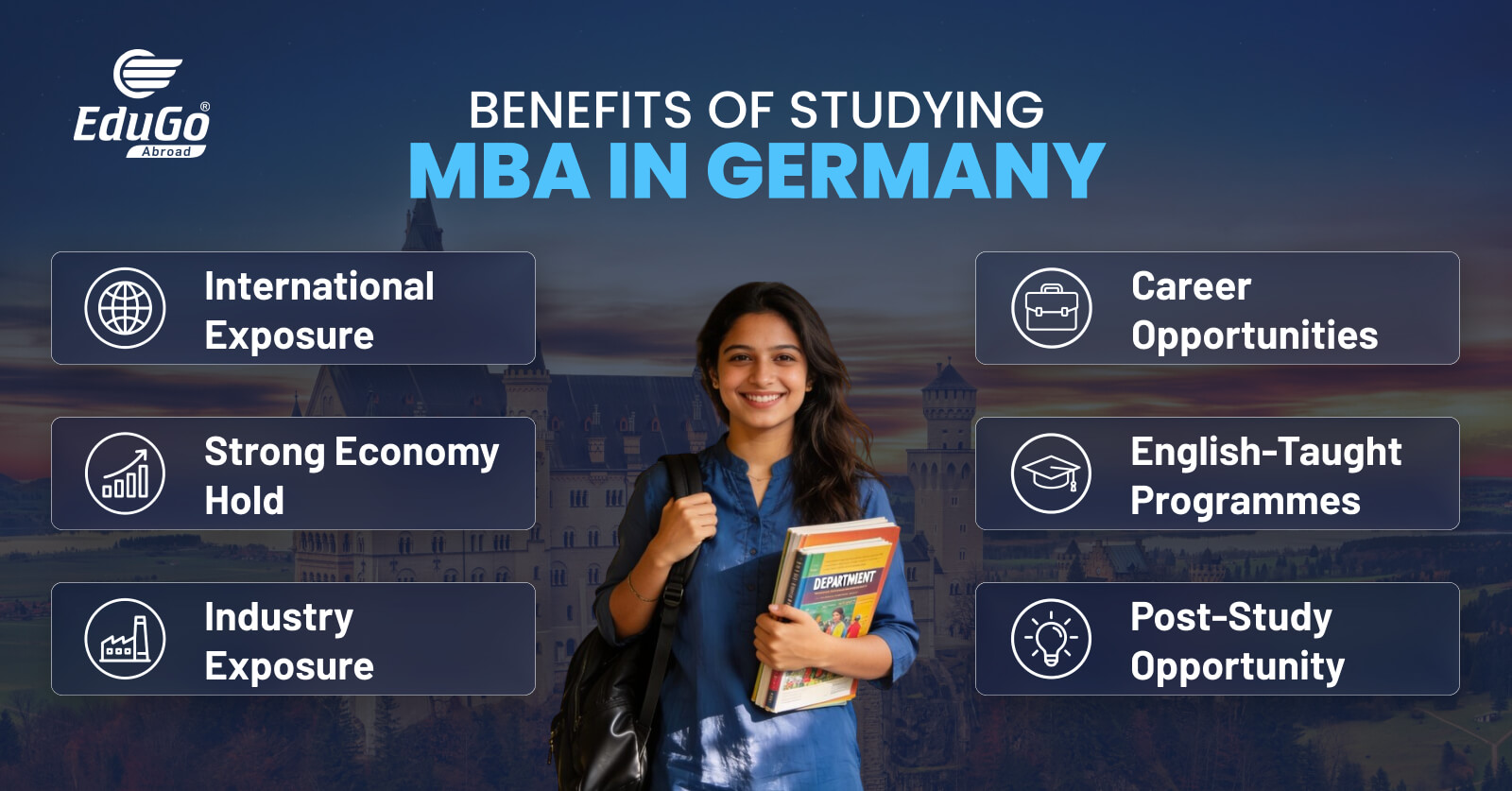
MBA in Germany can offer students more than a business qualification.
Germany has a large and diverse economy, which gives students exposure to different industries. Most MBA programmes focus on practical learning through:
- Case studies.
- Projects.
- Presentations.
- Internships and interaction with companies.
For international students, another major advantage is the opportunity to build a career in Germany after graduation. Eligible graduates can apply for a residence permit of up to 18 months to look for qualified employment after completing their studies.
Key Benefits at a Glance
| Benefits | Why It Matters |
|---|---|
| International Exposure | You get a chance to learn with students from different countries. |
| Strong Economy Hold | Access to a major European business market. |
| Industry Exposure | Opportunities to learn from real business cases. |
| Career Opportunities | Options across technology, finance, consulting and more. |
| English-Taught Programmes | Many MBA programmes in Germany offer lectures in English, making it beneficial for Indian students. |
| Post-Study Opportunity | Eligible post-graduates get a chance to stay and search for qualified work. |
Top Universities for MBA in Germany
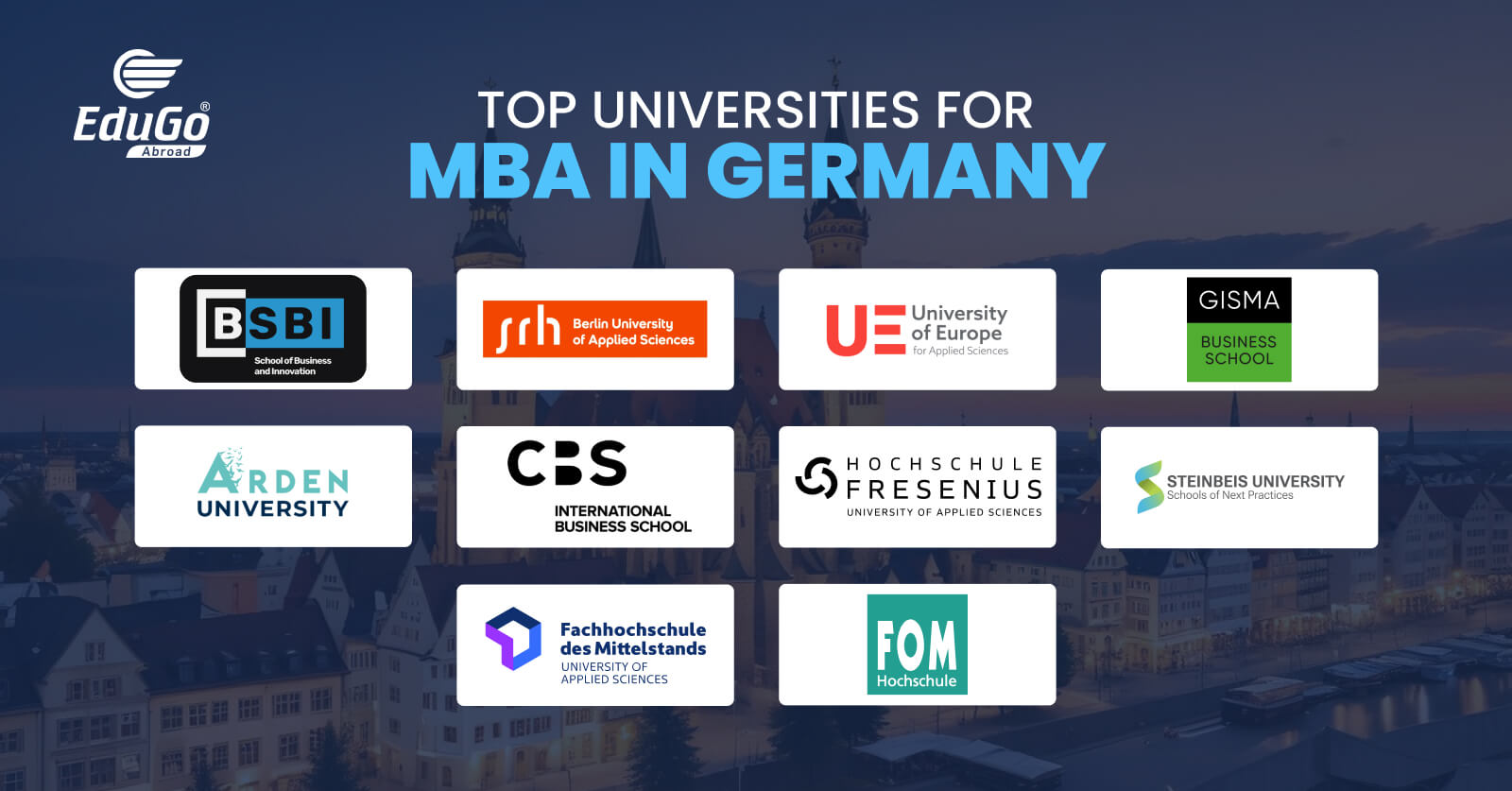
Choosing the right university is not only about rankings, but you should also know what it's known for, so you can make a well-informed and balanced decision that blends well with your future career goals.
| Universities | Key Highlights |
|---|---|
| Hochschule Fresenius University of Applied Sciences | With a 175-year legacy, it is known for its practical industry focus and strong career outcomes across business, science, and design in Germany. |
| FOM University of Applied Sciences | Known as Germany’s largest private university, it is recognised for flexible, career-focused business and management programs developed in collaboration with 10,000+ leading corporate partners. |
| University of Europe for Applied Sciences (UE) | It’s famous for a highly international environment, vibrant creative and tech campuses across Germany, and interdisciplinary programs blending art, design, business, and sports. |
| Berlin School of Business & Innovation (BSBI) | Known for its highly international student community, affordable, entrepreneurship-focused degree programs, and multi-city study options across Berlin, Hamburg, Paris, and Barcelona. |
| Arden University Berlin | Recognised for its career-focused UK-accredited degrees taught entirely in English in the heart of Berlin, combining flexible blended learning options with strong industry integration. |
| FHM University | Celebrated for its strong focus on small-to-medium enterprises (SMEs), small learning groups, and practical degree programs designed in close partnership with German industry leaders |
| Steinbeis University | Distinguished for its unique dual-education model, offering practical, project-integrated degree programs where students work directly on real-world business and technology projects with German industry partners. |
| GISMA Business School | Noted for its unique dual-education model, offering practical, project-integrated degree programs where students work directly on real-world business and technology projects with German industry partners. |
| CBS International Business School | Widely recognized for its state-accredited programs, top-ranked corporate management curriculum, and extensive network of 800+ global partner companies offering direct internships and employment paths. |
| SRH Berlin University of Applied Sciences | Distinguished for its innovative CORE teaching model (block-focused learning in small groups), diverse creative and management schools, and project-driven approach with strong industry partners. |
What Are the Top Specialisations for MBA in Germany
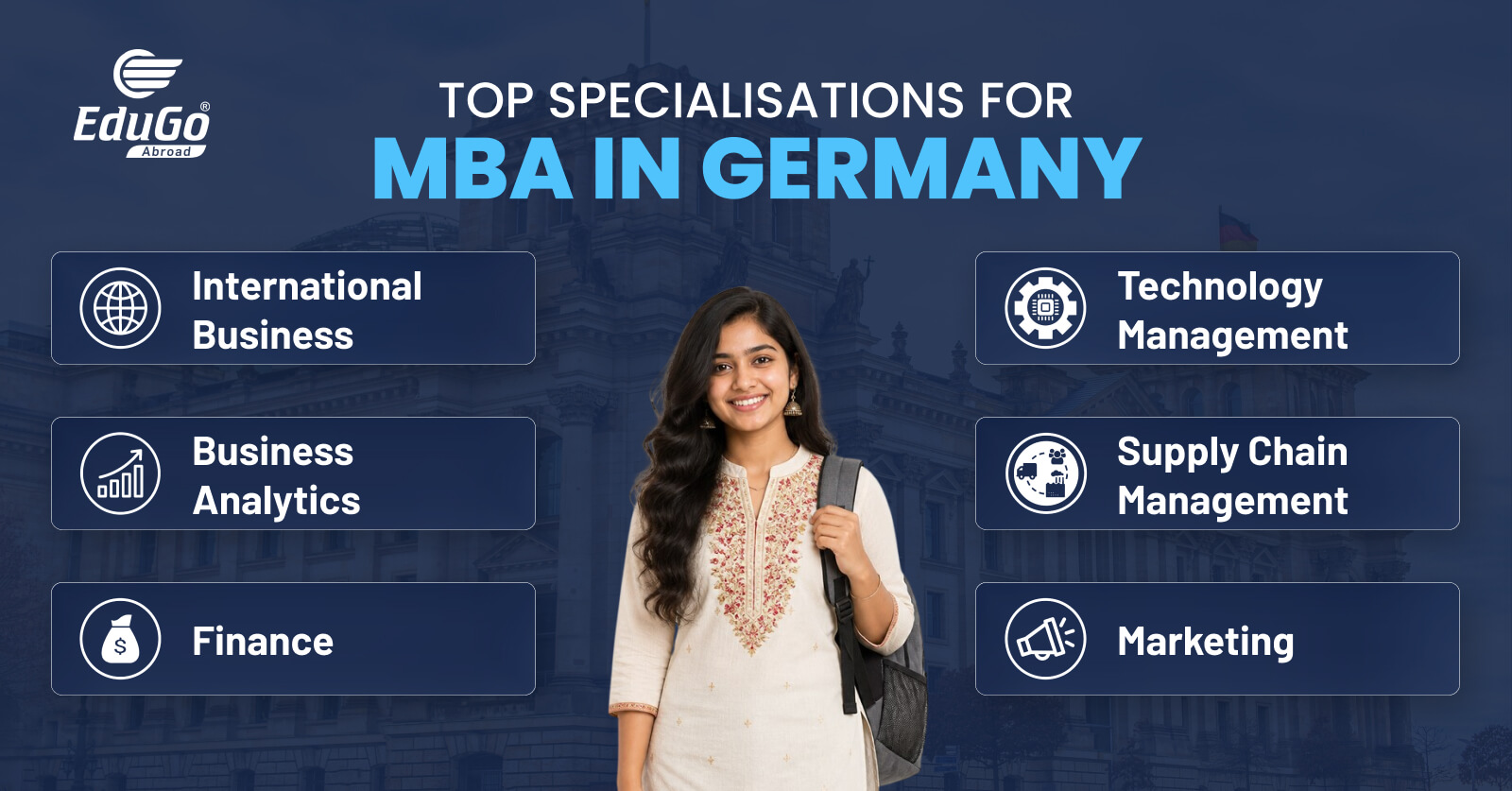
The specialisation you choose can influence the type of career you build after your MBA.
Now students should pay close attention to specialisations that connect business knowledge with Germany's changing economy.
1. Business Analytics
Businesses increasingly rely on data to make decisions. Business Analytics combines management with data-driven decision-making. This field is becoming more relevant as German companies invest in digitalisation, AI, automation, and data-based business processes.
2. Finance
Finance remains a strong MBA choice for students interested in banking, investment, financial planning, risk management, and corporate finance. It can lead to roles across banks, consulting firms, financial departments, fintech companies, and multinational businesses.
3. International Business
Germany's economy is strongly connected to international trade. An International Business MBA can help students understand global markets, cross-border operations, international strategy, and multinational management. This specialization suits students who want careers that involve working across countries and markets.
4. Marketing
Marketing has moved far beyond traditional advertising. Companies now need professionals who understand digital marketing, customer behaviour, brand strategy, social media, market research, and performance marketing. An MBA in Marketing can help students combine business strategy with modern marketing skills.
5. Technology Management
Technology is changing how companies operate. Germany's IT sector generated around €170 billion in annual turnover in 2026, according to the official Make it in Germany portal. The country also had more than 1.5 million skilled workers in the IT sector at the end of 2025. This makes Technology Management an interesting choice for students who want to combine business and technology.
6. Supply Chain Management
Germany has a major manufacturing and industrial base. Its automotive, engineering, logistics, and manufacturing sectors depend heavily on efficient supply chains. An MBA focused on Supply Chain Management can prepare students for areas such as procurement, logistics, operations, planning, and supply-chain strategy.
Why Germany Stands Out for MBA
The biggest attraction for any student in Germany is the combination of education, industry, and career opportunities.
Germany has one of Europe's strongest industrial economies. Its automotive sector alone generated €564 billion in revenue in 2023. [ Source: German government's Make it in Germany portal ].
For students, this means an MBA can be connected to a real business environment rather than being limited to classroom learning.
Apart from this, here are some other reasons why Germany should be on your list for pursuing an MBA course:
- Strong industrial, technology, and service sectors.
- Major opportunities across IT, finance, manufacturing, logistics, and consulting.
- Many international MBA programmes are being taught in English.
- Living expenses stays around €900–€1,200 per month.
- Up to 18 months post-study work rights to search for qualified employment after graduation.
- Strong exposure to global companies and international career opportunities.
Eligibility Requirements for MBA in Germany
Eligibility can vary by university and programme, but students generally need to meet these requirements:
Academic Requirements
Bachelor’s Degree: A recognised undergraduate degree is required. Many universities accept a 3-year degree (180 ECTS), while some may prefer a 4-year degree (210 ECTS).
Academic Score: Most programmes look for around 60%–70% marks or an equivalent 3.0/4.0 GPA.
Work Experience
Regular MBA: Usually requires 2–3 years of post-graduation work experience.
Executive MBA: Often requires 5–10 years of experience, including managerial experience for some programmes.
Freshers: Some management-focused programmes accept students without prior work experience. Always check the programme type and requirements.
GMAT/GRE Requirements
GMAT: A score of around 600–650+ can strengthen applications to competitive programmes.
GRE: A score of around 310–320+ can be a useful benchmark.
Waivers: Some universities may waive the requirement based on academic performance or professional experience.
Language Requirements
English-Taught MBA: Usually requires around IELTS 6.5–7.0 or TOEFL 90–100, depending on the university.
German-Taught MBA: May require recognised German proficiency such as TestDaF or DSH.
Basic German: A1/A2 can be useful for everyday life and networking, even when the MBA is taught in English.
Documents Required
SOP: Usually a 1–2 page statement covering career goals and motivation.
LORs: Often around 2 academic or professional recommendations.
CV/Resume: Highlight education, work experience, skills, and achievements.
Academic Records: Degree certificates and transcripts.
Test Scores: IELTS/TOEFL, GMAT/GRE, where required.
APS Certificate: Required for eligible Indian students applying to Germany. Check the latest APS rules before applying.
MBA in Germany: Fees and Cost of Living
Here’s the breakdown of the estimated costs you should know before picking your management course in Germany:
| Expense Category | Cost |
|---|---|
| Public Universities | €0 – €350 per semester |
| Private Business Schools | €10,000 – €40,000 per year |
| Accommodation | €350 – €800/month |
| Food and Groceries | €150 – €300/month |
| Transportation | €50 – €120/month |
| German Student Visa Fee | €75 (One-time fee) |
| Blocked Account Requirement | €11,904 per year |
| Health Insurance | €110 – €140/month |
| Residence Permit Fee | €100 – €120 (One-time fee) |
MBA Salary in Germany by Career Level
MBA salaries in Germany generally increase with experience, skills, and level of responsibility. Here’s an overview of the salary ranges you may see at different career stages:
Fresher / Early Career
Candidates with less than 3 years of experience can expect around €55,000 – €65,000 per year.
Mid-Level Professional
With 3 to 5 years of experience, MBA graduates can earn approximately €65,000 – €85,000 per year, with higher salaries possible in competitive industries and roles.
Senior Professional
Candidates with 5 to 8 years of experience may earn around €85,000 – €110,000 annually, particularly when they bring strong industry expertise or managerial responsibilities.
Leadership / Executive
Professionals with 10+ years of experience can earn approximately €120,000 – €180,000+ per year, depending on their position, industry, company, and leadership responsibilities.
Note: These figures are indicative and can vary based on role, location, employer, skills, and previous experience. Salary projections should not be treated as guaranteed earnings. [ Sources: Munich Business School Insights, Glassdoor Germany MBA Salaries, GMAC Alumni Perspectives Survey ]
Is an MBA in Germany Worth It?
For students aiming to build a career in the global business world, an MBA in Germany can be a valuable investment. It helps you gain global exposure, build practical business skills, and access international career opportunities.
But the best MBA is not necessarily the most expensive or the most highly ranked.
Before applying, ask:
- Does this MBA match my career goal?
- Can I afford the total cost of pursuing an MBA in Germany?
- Does the programme offer the specialisation I need?
- What work experience does the university require?
If Germany checks these boxes for you, it can be a strong destination for an MBA. And here’s where EduGo Abroad comes in! We help you find the right MBA programme on the basis of your academic profile, career goals, and budget, while guiding you through the entire application process.
Frequently Asked Questions (FAQs)
1Is Germany a Good Destination for an MBA?
Yes. Germany offers international business exposure and access to a large economy with strong technology, manufacturing, finance, automotive, and logistics sectors. The right programme will depend on a student's career goals and professional background.
2Can Fresh Graduates Study an MBA in Germany?
It depends on the university. Many traditional MBA programmes prefer or require professional work experience. Students without work experience should carefully check individual programme requirements.
3Which MBA Specialisation Is Best in Germany?
There is no single best specialisation. Business Analytics, Finance, International Business, Marketing, Technology Management, Supply Chain Management, and General Management can all offer different career paths.
4How Long Can I Stay in Germany After My MBA?
Eligible international graduates can apply for a residence permit of up to 18 months to search for qualified employment after graduation.
5 What Salary Can I Expect After an MBA in Germany?
There is no fixed salary. It depends on the role, industry, previous work experience, location, employer, and skills. Students should compare employment outcomes and salary data from individual universities before making a decision