
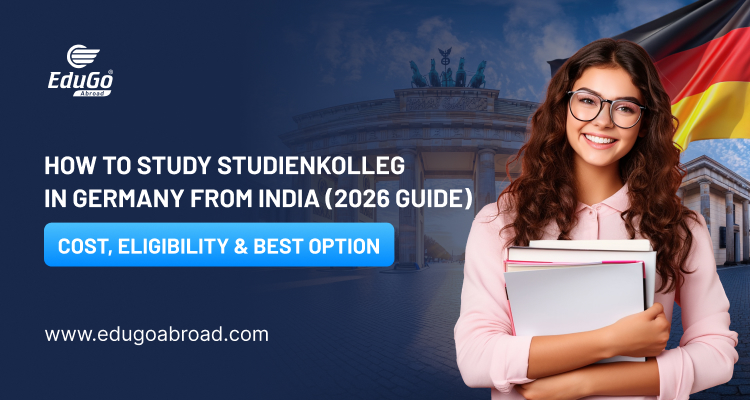
How to Study Studienkolleg in Germany from India (2026 Guide) Cost, Eligibility & Best Option
How to Study Studienkolleg in Germany from India (2026 Guide): Cost, Eligibility & Best Options
Germany is one of the most affordable and career-focused study abroad destinations for Indian students in Europe. German universities have low tuition fees, degrees that are recognized all over the world, and graduates have a lot of job opportunities in Germany. But international students have to complete an academic bridge program called Studienkolleg in Germany before they may go to university there straight after 12th.
To get directly into a university in Germany, you usually need to have completed school for 13 years. In India, you go to school for 12 years till Class 12. Many Indian students need to finish Studienkolleg in Germany before they may start their bachelor's degree because of this difference.
It's like a structured foundation course in Germany. It helps you become used to the way Germans teach, improve your basic knowledge of the subject, and learn the German language skills you need to do well in a degree program. You can go to university at the end of the course and you are much better prepared for it.
If you are planning to study in Germany in 2026, understanding how Studienkolleg works can save you time, money, and application mistakes
What is a Studienkolleg And Who Needs It?
A Studienkolleg is a 1 year preparatory program in Germany created for international students whose school-leaving certificate is not considered equivalent to the German Abitur (their university entrance qualification).
The program typically runs for two semesters and focuses on:
- Subject-specific academic preparation
- Advanced German language training
- University-level study skills aligned with German education
At the end of the course, students take the Feststellungsprüfung (FSP) which is a final assessment that determines whether you are eligible to apply for undergraduate programs in Germany.
Who Usually Needs Studienkolleg
You will most likely need Studienkolleg in Germany if:
- You completed Class 12 in India and want to pursue a bachelor’s degree in Germany.
- Your school qualification is not recognised for direct university admission in Germany.
- You are switching to a subject that requires specific academic prerequisites.
- A university or uni-assist evaluation explicitly states that your profile requires a preparatory course.
Who May NOT Need IT
You might qualify for direct admission in Germany if:
- You have already completed one year of a recognised bachelor’s program in India.
- You are applying for certain foundation-integrated programs.
- Your qualification meets German equivalency standards.
In simple terms, Studienkolleg is a gateway that ensures you enter a German university fully prepared and capable of keeping up with Germany’s rigorous education system.
Cost of Studienkolleg in Germany for Indian Students (2026)
| Type | Tuition Fees | Notes |
| Public Studienkolleg | €0 – €500/semester | Highly competitive |
| Private Studienkolleg | €5,000 – €12,000 total | Easier admission |
| Living Cost | €850 – €1,000/month | Same for both |
| Blocked Account | ~€11,904/year (2026) | Mandatory |
How Long Does Studienkolleg in Germany Last And What Does it Cover
The duration of Studienkolleg in Germany is typically two semesters, which equals about 10–12 months. It is a full-time foundation program, meaning you should expect a structured academic schedule similar to university life, usually 25–30 hours of classes per week, along with assignments, tests, and independent study.
What Subjects Are Taught in Studienkolleg in Germany?
The curriculum is not generic. It is designed around your future degree, which is why students are placed into subject-specific course tracks.
Here are the main Studienkolleg course types:
1. T-Course (Technical)
Ideal for students planning to pursue engineering in Germany, computer science, mathematics, or other technical degrees. Subjects often include advanced math, physics, chemistry, and technical German vocabulary.
2. M-Course (Medical)
Created for students targeting medicine, dentistry, pharmacy, or biology-related programs. Expect a strong focus on biology, chemistry, physics, and scientific terminology in German.
3. W-Course (Business & Economics)
Best suited for future business, management, finance, or economics students. Coursework typically includes mathematics, economics, business concepts, and academic German.
4. G-Course (Humanities)
Designed for degrees such as history, literature, sociology, or philosophy. Students develop analytical skills, academic writing, and high-level German comprehension.
5. S-Course / K-Course (Language & Cultural Studies)
Recommended for those interested in German language studies, translation, linguistics, or teaching-related pathways.
The Final Step: Feststellungsprüfung (FSP)
At the end of the program, every student must pass the Feststellungsprüfung (FSP), the official university qualification exam.
The FSP usually includes:
- Written exams in core subjects related to your track
- An oral examination that tests both subject understanding and German communication
Passing this exam grants you the university entrance qualification for Germany, allowing you to apply for bachelor’s programs in your chosen field.
Important: Your FSP score can influence which universities and programs you qualify for, so consistent performance during Studienkolleg matters.
How do I apply for Studienkolleg from India?
- Check if you actually need Studienkolleg. Use uni-assist or the university’s admission info to confirm whether your certificate qualifies for direct entry.
- Decide public vs private. Public is cheaper but competitive; private may offer English support and intensive German.
- Prepare documents: certified transcripts (with translations), passport, photos, CV, motivation letter, German language proof (if available).
- Register for the admission test (Aufnahmetest) or apply through the host university/uni-assist as required. Some Studienkollegs also accept international entrance letters issued before departure (rare but possible).
- Obtain student visa (national D-visa) once you have admission; show blocked account or financial proof per visa rules and Studienkolleg/university confirmation.
- Travel, enrol, attend classes and prepare for the FSP.
Which are the Best Public Studienkolleg Options in Germany?
Choosing a public Studienkolleg in Germany is often the first preference for international students, especially those looking for a high-quality education without heavy tuition costs. These institutions are government-funded, academically rigorous, and closely aligned with the German university system.
Why Do Students Choose Public Studienkolleg in Germany?
- Government-funded education: Most public Studienkolleg charge low or zero tuition fees, making them one of the most affordable pathways to enter a German university.
- Strong academic credibility: Since they are usually attached to public universities, the curriculum closely matches university expectations. This makes the transition into a bachelor’s degree much smoother.
- Recognised qualification: Passing the Feststellungsprüfung (FSP) from a public Studienkolleg is widely accepted across Germany.
- Multicultural classroom: You study alongside students from across the world, which helps build academic confidence and global exposure before university begins.
Popular Public Studienkollegs in Germany
-
Studienkolleg München (Munich)
One of the most competitive preparatory colleges, known for strong academic standards and excellent technical course preparation. Ideal for students targeting top universities in Bavaria.
-
Studienkolleg Frankfurt
Popular among international students due to its central location and strong W-course (business) and T-course (technical) offerings.
-
Studienkolleg Hannover
Well regarded for structured teaching, experienced faculty, and balanced academic support. A solid choice for engineering and science pathways.
-
Studienkolleg Leipzig
Often appreciated for its student-friendly environment and relatively affordable living costs compared to larger German cities.
Which are the Best Private Studienkolleg Options in Germany?
While public colleges are affordable, many students consider a private Studienkolleg in Germany for the flexibility and higher probability of admission.
Private does not automatically mean better but for some students, it can be the faster and more predictable route to university.
Why Do Students Choose Private Studienkolleg in Germany?
-
Easier admission process
Private providers typically have fewer applicants, reducing competition.
-
Predictable intakes
Many offer multiple start dates each year, so you may not have to delay your study plans.
-
English + German support
Some private programs provide partial English instruction in the early months while strengthening your German, helpful if you are still building language confidence.
-
Smaller class sizes
More personalized attention can make academic adjustment easier.
Benefits of Private Studienkolleg in Germany
- Direct subject coaching aligned with your intended degree
- Structured curriculum designed around the Feststellungsprüfung (FSP)
- Intensive exam-focused preparation
- Academic mentoring and progress tracking
Many private institutions promote a higher FSP success rate, largely because of smaller cohorts and targeted exam training.
Public vs Private Studienkolleg in Germany
| Feature | Public Studienkolleg in Germany | Private Studienkolleg in Germany |
| Tuition Fees | Low or zero tuition; students usually pay only a semester contribution | Higher tuition fees, often ranging from €5,000–€15,000 per year |
| Admission Difficulty | Highly competitive with limited seats | Easier admission with higher acceptance rates |
| Entrance Exam | Mandatory Aufnahmetest in most cases | May have internal assessments; some are less competitive |
| German Language Requirement | Typically B1–B2 German required before entry | Some accept lower levels and provide intensive German training |
| Teaching Language | Primarily German | Often German-focused but may offer partial English support initially |
| Class Size | Larger classrooms | Smaller batches with more personalised attention |
| Academic Structure | Traditional and academically rigorous | Structured, exam-oriented approach with close mentoring |
| FSP Preparation | Strong academic foundation but requires self-discipline | Targeted coaching with heavy focus on Feststellungsprüfung (FSP) success |
| Intake Flexibility | Usually one major intake per year | Multiple intakes possible, reducing wait time |
| University Recognition | Widely recognised across German universities | Recognition depends on the provider; always verify before enrolling |
| Best For | Students with strong academics and good German skills who want an affordable pathway | Students seeking a safer admission route, faster timeline, or additional academic support |
Can You Study in Germany Without Wasting 1 Year?
1. FHM University – Parallel Pathway
The FHM University parallel pathway is becoming a popular alternative to Studienkolleg in Germany, especially among students who want to begin their degree without spending an extra year in a foundation program.
Instead of completing a separate preparatory course, students enroll in a bachelor’s program with confirmed admission while simultaneously completing the academic preparation required for university-level study.
Why This Pathway Stands Out
- Confirmed bachelor’s admission from the beginning
- Preparatory modules conducted alongside your degree
- Helps save one full year of living costs in Germany
- Maintains academic continuity without a study gap
- Provides a structured transition into the German higher education system
This pathway is ideal for students who already have clarity about their career direction and prefer a faster route to studying in Germany.
Best suited for:
Students prioritising time efficiency, cost optimisation, and a direct university pathway in Germany.
2. FOM – 2-Month Preparation Program
For students who find the traditional foundation route too long, the FOM preparation program offers a short-term alternative to Studienkolleg that accelerates university entry.
With a duration of roughly two months, this pathway focuses on bridging academic gaps quickly so students can transition into their bachelor’s degree sooner.
Key Advantages
- Short duration (about 2 months) compared to the typical one-year Studienkolleg
- Faster progression into a bachelor’s degree in Germany
- Academic and language readiness support
- Suitable for students with relatively strong academic backgrounds
This option works particularly well for applicants who already meet most eligibility criteria but require limited preparation before starting university.
Best suited for:
Students seeking a fast-track study pathway in Germany without committing to a year-long preparatory course
Final Thoughts: Is Studienkolleg in Germany Worth It?
For many Indian students, Studienkolleg in Germany is a smart academic foundation. It strengthens subject knowledge, improves academic German, and prepares you for the expectations of a university in Germany.Students who complete Studienkolleg usually transition more smoothly into their bachelor’s degree, handle coursework with greater confidence, and reduce the risk of academic setbacks.
If you are unsure which route is right for you, seeking expert guidance can prevent costly mistakes and save valuable time. This is where experienced mentors make a real difference.
How Edugo Abroad Supports Your Studienkolleg Journey
- Profile evaluation to determine whether Studienkolleg in Germany is required
- Guidance on choosing the right pathway (public, private, or fast-track options)
- Shortlisting universities and preparatory colleges based on your academic goals
- End-to-end application support with document preparation
- Assistance with German student visa and blocked account process
- Pre-departure guidance to help you transition smoothly to Germany